




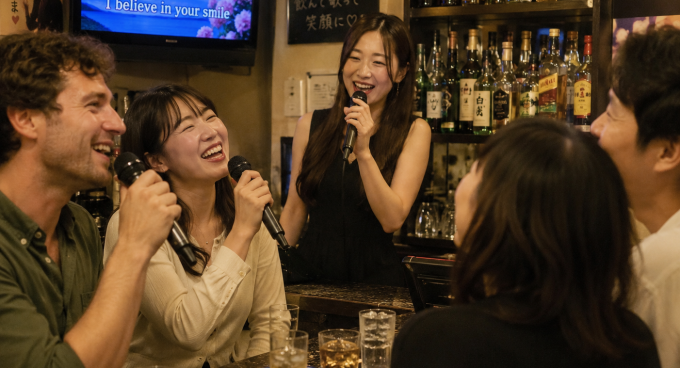
I think travelers coming to Japan from abroad should visit bars called ‘snack bars,’ which operate under a peculiar system. That’s because at these ‘snack bars,’ you can learn about the characteristics of the area and its people, and encounters with unique individuals await you.
Even with language barriers, smartphone apps can help you out. And alcohol and karaoke should round out your nighttime fieldwork.
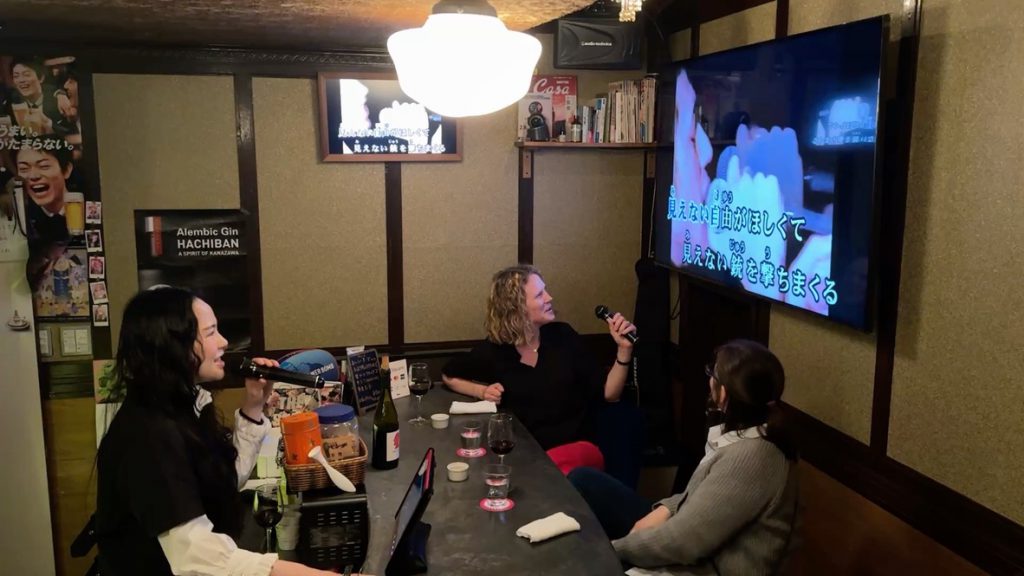
It is said that there are between 50,000 and 100,000 snack bars, or possibly even more, in Japan. Unfortunately, there is no equivalent term for this ‘snack bar’ in English-speaking countries.
Japanese “snack bars” can be easily understood as “hostess bars” or “small-scale hostess bars.” They are small drinking establishments centered around socializing, where customers enjoy drinks and light snacks while conversing with each other and the staff. Service is provided by the female owner, often called the ” Mom” and female staff members from behind the counter.
In preparation for the 1964 Tokyo Olympics, public order enforcement was strengthened with foreign tourists’ impressions in mind, restricting late-night alcohol service and coffee shop operations in major cities. However, since alcohol could still be served late at night under the guise of providing light meals (snacks), a prevailing theory holds that Japan’s unique “snack” establishments—short for snack bars—sprang up in droves.
Then, karaoke machines—believed to have begun spreading in the late 1960s—were introduced into ‘snack bars’. This spurred lively interaction among patrons, forming the karaoke culture that continues today and rapidly spreading widely to rural areas. It became commonplace even on small islands to have izakaya and snack bars, even if bars were absent, and this continues today. Furthermore, snack bars, once thought to be in decline, have seen a generational shift in their clientele and have become popular with younger generations seeking the kind of old-fashioned social interaction they offer.
Even though snack bars have become widespread, their doors can still be very difficult to open, regardless of whether you’re Japanese or foreign. Sometimes you can just drop in for the first time and have a fantastic night as if you’d been going there for years, but other times it doesn’t go so smoothly. (But that’s part of the fun of snack bar hopping…)
Therefore, it’s best to understand that the proper way to enter such a shop is to have someone familiar with it introduce you or accompany you there once.
Especially for international travelers, it might be difficult to enter a ‘snack bar’ without knowing if they speak your language, so we recommend looking for establishments or tours that accept reservations from overseas.
And once you break the ice, you’re warmly welcomed by the snack bar’s “Mom,” and the regular customers. In other words, the ‘snack bar’ is truly a second home, and the people there are like another family.
For those who say they’d rather not bother visiting such a troublesome and peculiar establishment as a ‘snack bar,’ I recommend going to a regular bar or izakaya instead. However, if you go to a ‘snack bar’ where you can socialize without barriers like age, gender, or wealth, you can gain all sorts of knowledge and information. You might find out right away where and what to eat tomorrow for lunch, and someone might even volunteer to be your guide.
What is a snack?
Have you heard of ‘My Bottle’?
The primary element constituting a ‘snack bar’ is the proprietor, who is also the landlady, known as the ‘Mom’ It is correct to think of a ‘snack bar’ as a home where the ‘Mom’ is the center, and the customers, who are the Mom’s children, gather.
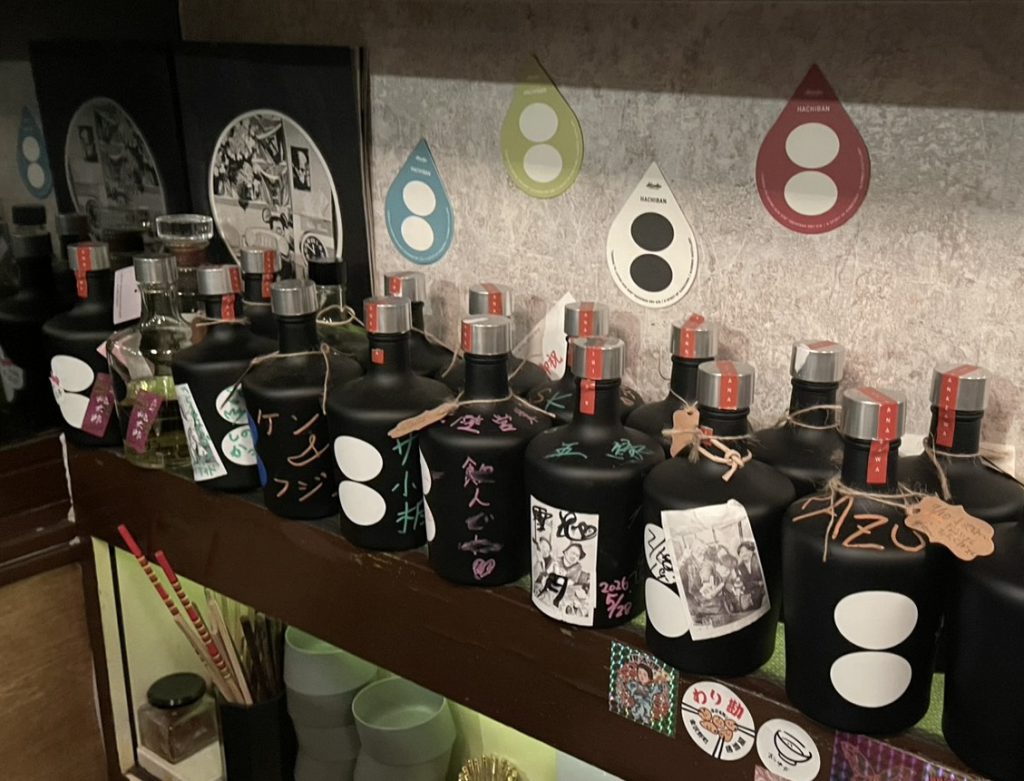
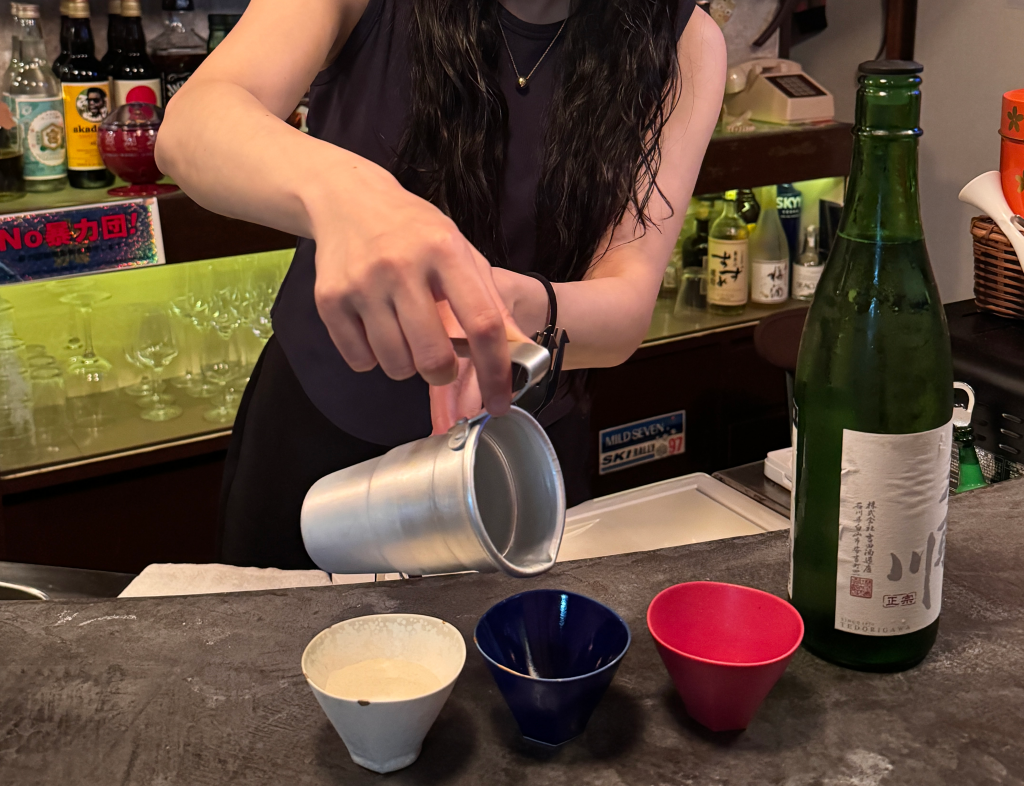
And what about the drinks, which are the whole point? While some snack bars now serve a variety of drinks like regular bars, the basic system is bottle keep, where you purchase your own bottle of liquor and have it stored for you. This bottle is called your “my bottle.”
Many customers often order their drinks from the “My Bottle” selection as “watered down” or “stronger” and drink them as “watered-down drinks.” This is said to be the custom at snack bars.
<My Bottle> primarily features whiskey and shochu. Upon purchase, a tag with your name (usually a nickname) is hung around the bottle’s neck. You can also draw pictures or write messages on the bottle using a white ink marker.
After that, you just pay the entrance fee each time you visit the shop. There’s no time limit on your stay, and this fee includes unlimited karaoke singing. Of course, don’t forget to pass the microphone to other customers.
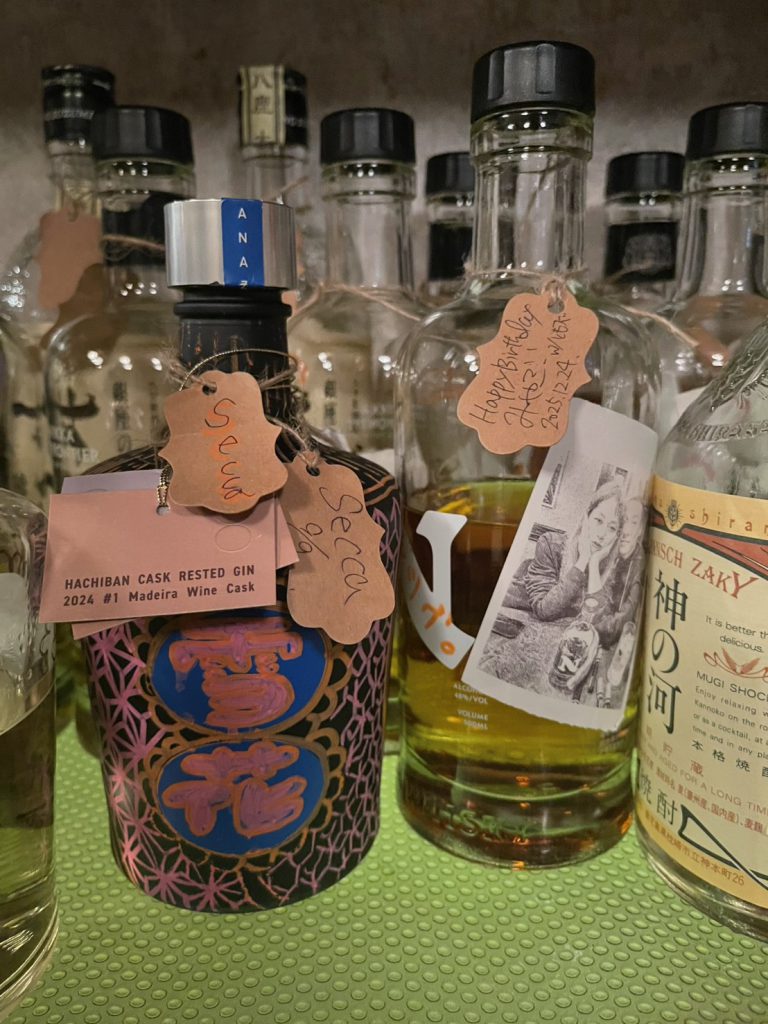
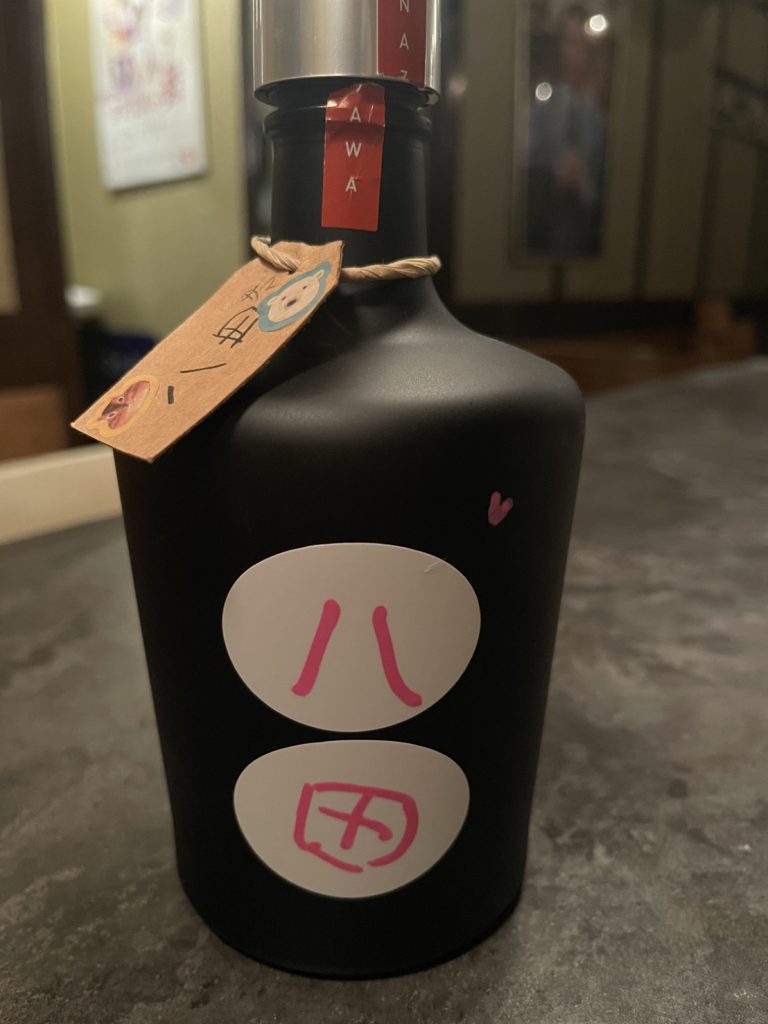
While enjoying your time at the snack bar, if your personal bottle runs empty, “Mom” or other staff will ask if you’d like to purchase a refill. Keeping your personal bottle constantly filled and stored at the bar is proof that you belong to that snack bar’s family.
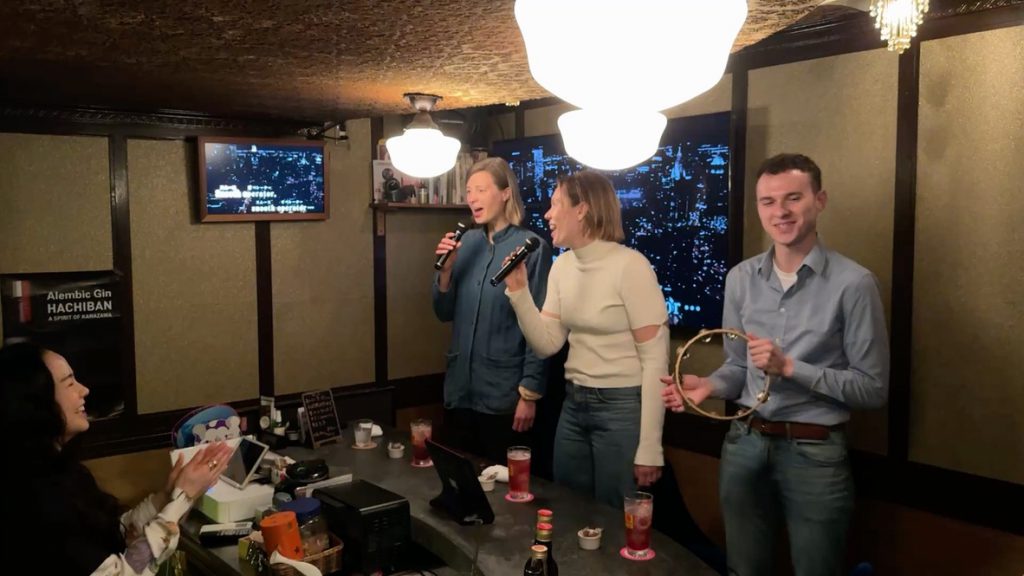
And it’s true that singing through karaoke helps us join this small world’s community. Even just clapping along without singing is fine. Unlike karaoke boxes where only people you know gather to sing, singing in front of strangers is also part of the charm of a ‘snack bar’.
This is a business model unlike any other in the world.
Next to “Mom”, the ones running that ‘snack bar’ are the regulars who are positioned as Mom’s children. They’re usually called by nicknames. There might be presidents of well-known companies or university professors among them, but inside the ‘snack bar,’ none of that matters. And while they’re customers, if Mom asks them to, they’ll run out to buy more soda water or ice when it runs low.
You could say this is a business model unlike any other in the world.
Regular customers pay to frequent the place and even help with tasks the shop should handle.
They do this to contribute to keeping their second home from disappearing. I hope visitors from abroad won’t find this strange sight peculiar.
And as for the light meals that gave bars the name “Snack”—originally, staples like “grilled udon noodles” made in the bar’s small kitchen were common. But nowadays, few places serve light meals. Instead, what we call “snacks” (junk food) are often provided for free.
Why are snack bar hostesses called “Mama(Mom,Mam)”?
By the way, have you ever wondered why the woman who runs a snack bar is called “Mama”? There are various theories, but originally, the managers and owners of bars and similar establishments were predominantly male. It’s thought that this name spread with the emergence of snack bars.
One theory suggests it evolved from “Madame” to “Mama(Mom),” a remnant of referring to female business owners as “Madame.” Another theory posits that while women managing restaurants were called “okami” (female proprietor), the Western-style “Mama” was adopted instead. Yet another theory states it came into use because they became like a “second mother” figure, providing emotional support to customers.
One theory suggests that the American occupation forces after the war referred to the women running the shops as “mam “.
※This article uses ‘Mam’.
In any case, ‘Mama’ is not merely a hostess, but a knowledgeable, friendly, and supportive partner who stays close to customers, offering advice on life matters and remaining a reassuring presence. That said, it’s true that ‘Mamas’ resembling daughters or younger sisters have been appearing more frequently in recent years.
As a result, it seems that “Mom” has recently become a title, and people are now being called by their names.
Etiquette for Your First Visit to a Snack Bar
You might wonder, “Are there really etiquette rules for drinking?” But visiting an unfamiliar snack bar is like going to someone’s house for the first time. Let me explain the manners for that occasion.
When you enter a snack bar, first confirm the charges with Mom. Some establishments offer all-you-can-drink for a fixed price instead of a bottle-keep system, so be sure to check the time limit and other details. Note that some drinks may incur extra charges even with all-you-can-drink.
Once you’re seated, start by toasting with Mom for the first time. Since this isn’t a bar, it’s best to refrain from ordering cocktails or similar drinks. It’s a good idea to offer Mom drink as well.
After a while, the karaoke remote for song selection will be passed around by Mom, staff, and regulars. It’s considered good manners for newcomers to decline once or twice. While the freedom to sing whatever you like is part of karaoke’s appeal, when visiting a new place, it’s recommended to start by choosing songs within your own range, observing the atmosphere and the song history sung by the regulars.
And the key action is clapping along. By clapping in time with the regulars and others singing, a sense of unity fills the entire snack bar. Then, when your turn to sing comes, try singing just a little bit more softly. After all, this is someone’s home you’re visiting for the first time. Save the lively singing for later.
Snack Punch in Kanazawa: A Place Foreigners Can Visit with Confidence.
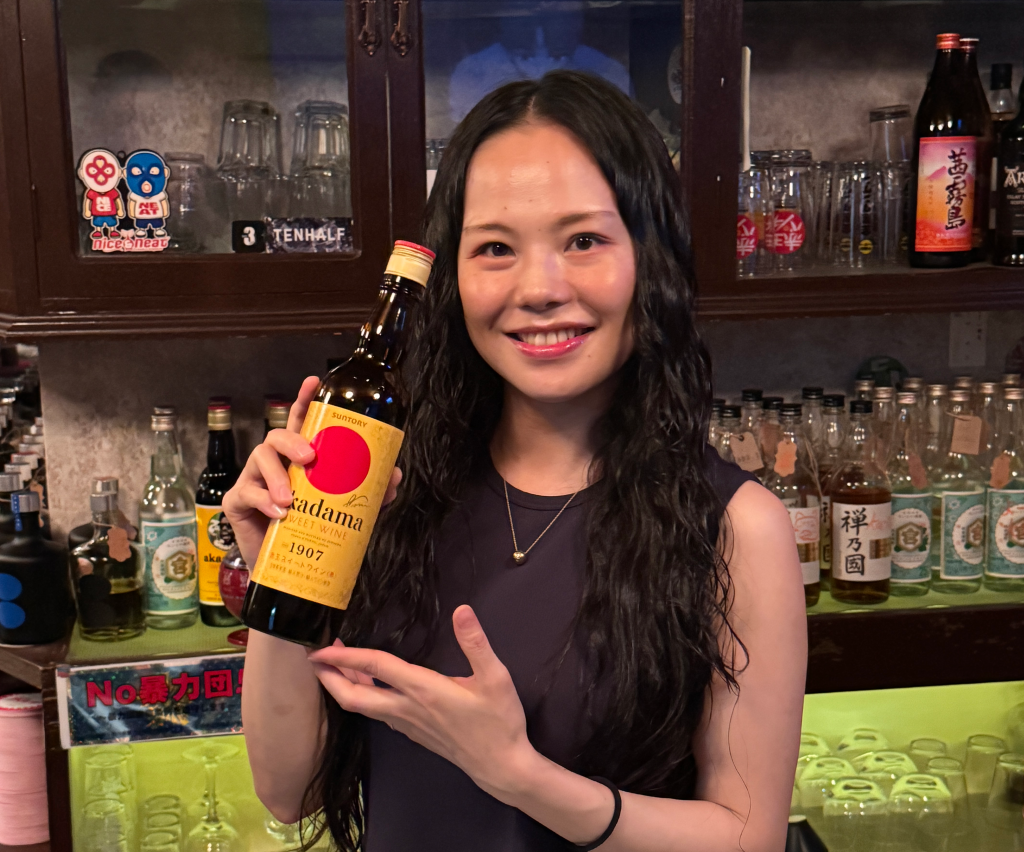
‘Snack Punch’ is located in Katamachi, a bustling entertainment district in Kanazawa City. The venue operates on a referral-only basis. First-time visitors must be introduced by a regular patron. However, this ensures you can enjoy yourself with complete peace of mind.
However, as this restaurant is due to start accepting bookings from foreign tourists very soon, we recommend checking their Instagram page.
https://www.instagram.com/snack.punch/

text : Joji Itaya
出版にたずさわることから社会に出て、映像も含めた電子メディア、ネットメディア、そして人が集まる店舗もそのひとつとして、さまざまなメディアに関わって来ました。しかしメディアというものは良いものも悪いものも伝達していきます。 そして「食」は最終系で人の原点のメディアだと思います。人と人の間に歴史を伝え、国境や民族を超えた部分を違いも含めて理解することができるのが「食」というメディアです。それは伝達手段であり、情報そのものです。誰かだけの利益のためにあってはいけない、誰もが正しく受け取り理解できなければならないものです。この壮大で終わることのない「食」という情報を実体験を通してどうやって伝えて行くか。新しい視点を持ったクリエーターたちを中心に丁寧にカタチにして行きたいと思います。